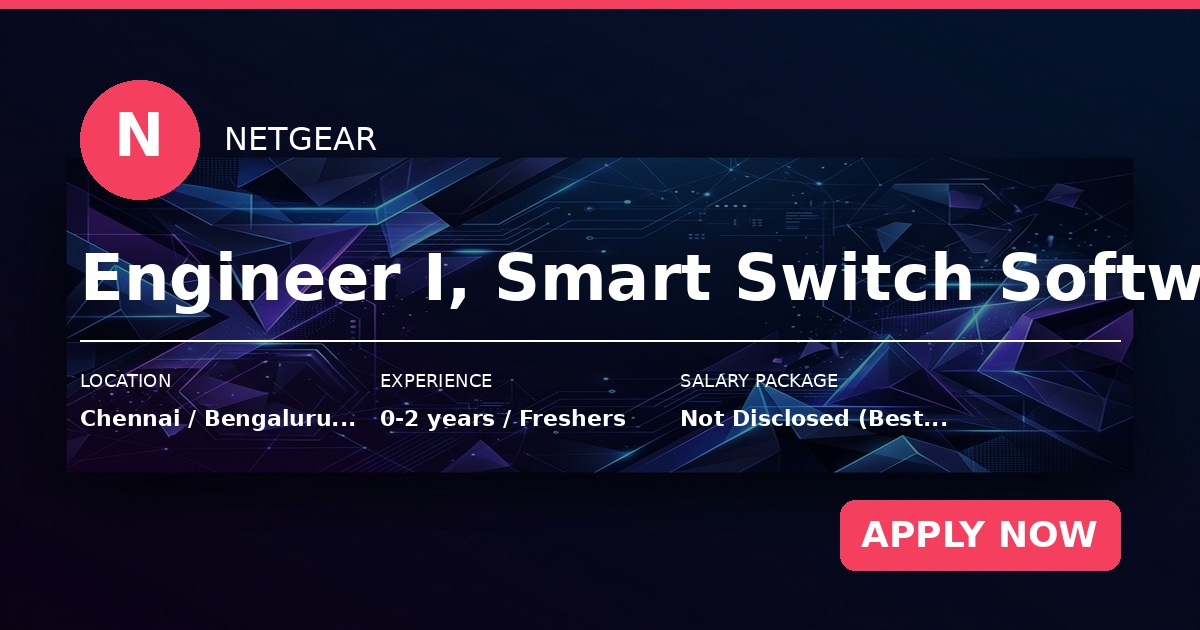
NETGEAR Hiring Drive 2026: Engineer I - Smart Switch Software Development
If you are a fresher or an early-career engineer passionate about low-level programming, embedded C, and core computer networking, here is a fantastic job opportunity for you. NETGEAR, one of the world's leading networking companies, has opened applications for the position of Engineer I, Smart Switch Software Development. This role is ideal for candidates looking to build a strong engineering career in firmware development and networking protocols.
Job Overview Table
About NETGEAR
Founded in 1996, NETGEAR has been a pioneer in internet connectivity and networking technologies. The company powers home networks, businesses, and enterprise systems globally with smart routers, enterprise switches, and cloud-managed systems through the NETGEAR Insight platform. Their Smart Switch line is particularly famous among small and medium-sized businesses for high reliability and manageable L2/L3 networking.
NETGEAR is setting up and expanding a modern engineering center in Chennai to build next-generation switch firmware. This means if you join now, you get to be part of a growing core team working directly on production firmware that runs on millions of devices around the world.
Detailed Role Description & Work Environment
As an Engineer I in the Smart Switch firmware team, you will focus on entry-level yet high-impact firmware development. You won't just write simple application code; you will work close to the hardware layer, interacting with Linux kernel modules, board support packages, and standard network routing protocols.
What makes this role special is the push toward AI-assisted software development. NETGEAR encourages engineers, even fresh graduates, to use AI coding assistants like GitHub Copilot, Cursor, and Claude Code. This helps you learn codebases faster, automate repetitive setup tasks, write tests, and debug faster while relying on senior mentorship for core technical architecture.
Key Day-to-Day Responsibilities:
- Embedded C Coding: Write clean, fast, and defensive C code for user-space daemons, system libraries, and Linux kernel modules running on ARM64 and MIPS hardware platforms.
- Device Drivers & Board Support: Work alongside senior architects to write device drivers, maintain BSPs, and interact with the Switch Hardware Abstraction Layer (HAL).
- Networking Protocols: Implement and optimize networking protocols including VLANs, Spanning Tree Protocol (STP/RSTP), LLDP, IGMP Snooping, LACP, and Access Control Lists (ACLs).
- Debugging & Issue Resolution: Troubleshoot complex issues using tools like GDB, strace, tcpdump, and Wireshark across kernel and application layers.
- Hardware Lab Work: Spend hands-on time in the lab connecting to switch consoles over serial ports, packet generators, and JTAG debuggers to test your code on physical hardware.
- AI Workflow Usage: Integrate modern AI coding agents into your daily coding, debugging, and documentation habits.
Eligibility Criteria & Educational Background
Candidates applying for this entry-level role should meet the following basic qualifications:
- Degree: B.Tech, B.E., M.Tech, or M.E. in Computer Science (CSE), Electronics and Communication (ECE), Electrical Engineering (EEE), or equivalent technical streams.
- Batch Eligibility: Recent graduates from 2023, 2024, 2025, or upcoming 2026 batches with 0 to 2 years of relevant experience.
- Core Foundation: Strong hold on data structures, C pointers, memory management, and operating system internals.
Technical Skills Needed
Pro Tip for Candidates: Emphasize your understanding of memory management, pointer arithmetic, bitwise operations, and packet handling in your resume. Projects involving Raspberry Pi, OpenWrt, or custom socket programming stand out significantly!
Must-Have Skills:
- Strong C Programming: Pointers, dynamic memory allocation, structures, bit manipulation, and standard libraries.
- Linux Environment: Familiarity with GCC compilation, Makefiles, standard shell tools, and Git version control.
- Networking Basics: Clear concepts on OSI model, Ethernet frames, TCP/IP stack, ARP, IP addressing, and subnetting.
- OS Fundamentals: Processes, threads, concurrency, inter-process communication (IPC), and hardware interrupts.
Good to Have (Bonus Skills):
- Experience with Linux device drivers or kernel module programming (`/proc` and `/sys` interfaces).
- Hands-on work with packet capture tools like Wireshark or tcpdump.
- Basic scripting knowledge in Python or Bash for automation.
- Prior open-source contributions, competitive programming background, or personal firmware projects on microcontrollers/Raspberry Pi.
Selection Process
While exact round details can vary, NETGEAR's typical hiring workflow for engineering roles consists of:
- Resume Shortlisting: Filtering based on relevant skills (Embedded C, Linux, Networking projects).
- Online Assessment / Technical Screening: MCQs and coding tasks covering C concepts, pointers, bitwise logic, and networking basics.
- Technical Interview Round 1: Deep dive into core C programming, memory leaks, OS concepts, and resume projects.
- Technical Interview Round 2: Problem-solving on networking protocols, debugging scenarios, and Linux internals.
- HR & Leadership Round: Culture fitment evaluation, discussing team expectations, and offer negotiation.
How to Apply Step-by-Step
Ready to jumpstart your career in core systems and embedded software? Follow these simple steps to submit your application:
- Click on the official apply button below to land directly on the job application page.
- Upload an updated PDF resume highlighting C programming projects, Linux coursework, or networking certifications.
- Fill out your contact details, education history, and link your GitHub or LinkedIn profile if available.
- Review your application and submit. Make sure to check your email regularly for updates.
Note: Share this opportunity with your batchmates and friends interested in embedded systems and computer networks!