
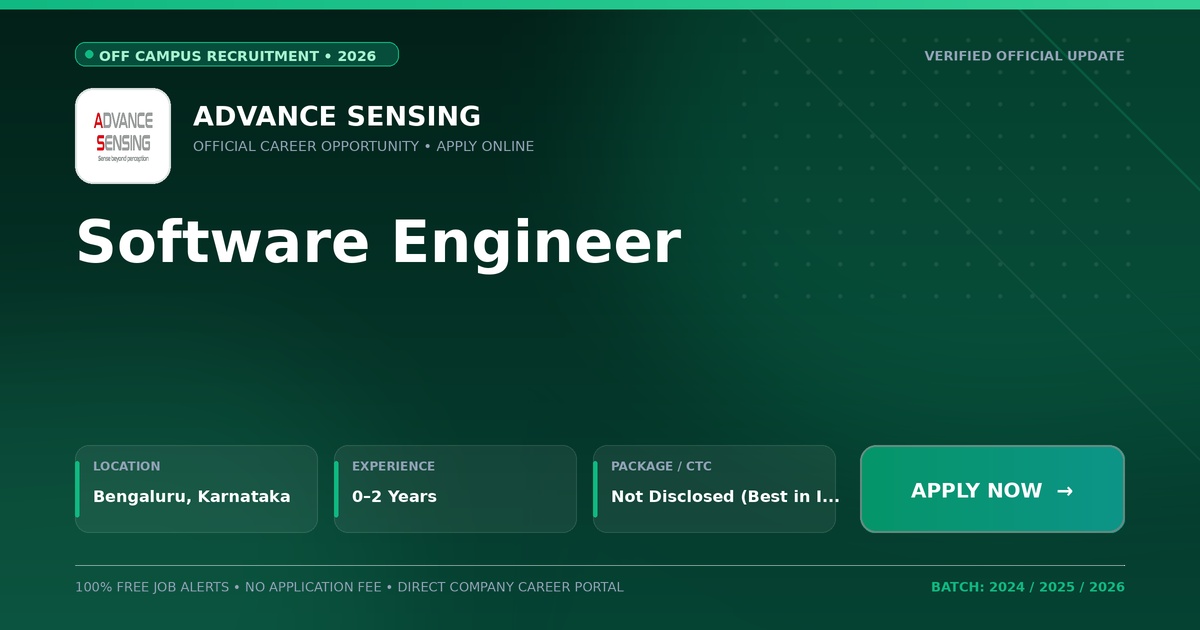
Advance Sensing Hiring Software Engineer | Freshers & Early Career Engineers
Are you a fresher or an early career professional looking to build a career in software development that goes way beyond basic CRUD web apps? If you have always wanted to work on software that actually talks to real hardware—like industrial cameras, smart sensors, automated production lines, and artificial intelligence models—this opportunity is right up your alley. Advance Sensing has rolled out a direct hiring notification for the role of Software Engineer based at their Bengaluru office.
Job Overview Table
| Company Name | Advance Sensing Private Limited |
|---|---|
| Job Role | Software Engineer |
| Experience Required | 0 – 2 Years (Freshers & Experienced) |
| Educational Qualification | B.E / B.Tech or equivalent degree |
| Job Location | Bengaluru, Karnataka (Pin: 560078) |
| Salary Package | Best in Industry (Commensurate with skills) |
| Application Mode | Online Registration |
About Advance Sensing
Advance Sensing Private Limited is an engineering-driven company based out of Bengaluru, Karnataka. The firm brings together more than 30 years of deep industry expertise alongside a vibrant, tech-savvy team of engineers. They specialize in high-end machine vision systems, artificial intelligence-powered industrial inspection platforms, industrial sensing, and smart manufacturing (Industry 4.0) automation solutions.
Unlike conventional IT services companies where you might get stuck maintaining legacy databases or writing generic templates, Advance Sensing creates high-precision systems. Their products directly impact real-world assembly lines, automotive manufacturing units, electronic production setups, and pharmaceutical plants. They help top manufacturers identify defects, track traceability, reduce manual errors, and scale smart automation.
Detailed Job Description & Responsibilities
As a Software Engineer at Advance Sensing, you will be designing, building, and deploying the core software applications that power automated visual inspection and factory data networks. You will primarily use Python and Java to develop backend services, data pipelines, APIs, and user interfaces that communicate directly with industrial hardware.
Here is an in-depth look at what your day-to-day responsibilities will look like:
- Core Application Development: Write, test, and maintain solid, clean code using Python and Java for real-time industrial inspection applications.
- Industrial Vision Integration: Build software modules that talk directly to industrial cameras, optical lenses, specialized lighting triggers, and sensing hardware.
- Backend Services & API Creation: Develop high-performance backend microservices and RESTful APIs to feed data between hardware machines, local processing units, and cloud systems.
- Database Management: Set up, optimize, and manage relational databases (like MySQL and PostgreSQL) to log high-resolution image data, inspection scores, and quality logs.
- Analytics and Dashboards: Build tools and dashboards that give factory floor operators and quality managers instant visual reports, defect charts, and performance graphs.
- Testing, Optimization & Debugging: Benchmark code execution speed, handle multi-threaded processing so that image captures happen without any lag, and fix bugs quickly.
- Multidisciplinary Collaboration: Work alongside AI/ML researchers, embedded automation engineers, and mechanical designers to build complete, plug-and-play smart factory solutions.
- Deployment & Documentation: Prepare structured release notes, user manuals, and configuration files, helping during customer commissioning when necessary.
Eligibility Criteria
Candidates looking forward to applying for this recruitment drive must satisfy the following conditions:
- Educational Qualification: B.E / B.Tech in Computer Science, Information Technology, Electronics & Communication, Electrical Engineering, Instrumentation, or equivalent technical disciplines.
- Experience Range: 0 to 2 years of relevant hands-on programming experience. Freshers with strong personal projects, open-source work, or relevant internship experience are welcome to apply.
- Backlogs / Arrears: Having a clear academic track record without active backlogs is preferred.
- Work Location: Willingness to work on-site out of their Bengaluru office.
Required Technical Skills & Competencies
The hiring team at Advance Sensing values strong fundamentals over superficial tool knowledge. Here are the core technical competencies you should possess:
- Object-Oriented Programming (OOP): Clear grasp of classes, objects, inheritance, encapsulation, polymorphism, and modular coding patterns.
- Python Proficiency: Solid knowledge of Python fundamentals, working with libraries, script automation, data parsing, and file handling.
- Java Knowledge: Basic to intermediate knowledge of Java syntax, data structures, multithreading, and scalable backend logic.
- Database & SQL Skills: Ability to write SQL queries, create tables, join data sources, and manage transactions in relational databases like PostgreSQL, MySQL, or SQLite.
- Web Concepts & APIs: Good understanding of HTTP methods, REST architecture, JSON payloads, and network sockets (TCP/IP).
- Version Control: Hands-on familiarity with Git commands (commit, push, pull, branch, merge) and collaborative code repositories like GitHub or GitLab.
- Problem Solving: Strong analytical mindset with the ability to quickly debug production logs and troubleshoot unpredictable technical issues.
Preferred Additional Knowledge (Good to Have)
- Experience with multithreading, concurrency, or asynchronous programming in Python or Java.
- Basic Linux command line knowledge and shell scripting.
- Exposure to GUI development frameworks (like PyQt, Tkinter, JavaFX, or simple web frontends).
- Interest in computer vision, image processing (OpenCV), and artificial intelligence concepts.
Selection Process & Hiring Workflow
The recruitment process at Advance Sensing typically follows a structured, practical approach designed to test your problem-solving capabilities:
- Resume Shortlisting: Applications are screened based on technical projects, academic background, GitHub portfolios, and internship track records. Make sure you highlight your Python/Java projects clearly.
- Technical Screening / Coding Round: A round evaluating your core coding fundamentals, basic algorithms, data structure implementation, and logic building.
- Technical Discussion Round: In-depth interaction with the senior engineering team. Questions will focus on your past projects, object-oriented design, databases, system debugging, and how you would design an inspection data workflow.
- Managerial / HR Round: Discussion on culture fit, career goals, role expectations, compensation, and onboarding timelines.
Helpful Tips for Candidates
Before submitting your application, take a look at these actionable tips to improve your chances:
- Showcase Practical Projects: If you built an image recognition script, an IoT sensor logger, or a multi-threaded backend server during college, put a live GitHub link on your resume.
- Revise Database Concepts: Make sure you can write clean SQL queries and explain relational schema design without hesitating.
- Highlight Problem Solving: Be ready to explain not just what your code does, but why you picked a particular approach or data structure over another.
How to Apply for Advance Sensing Software Engineer Role
Eligible and interested candidates can apply directly on the official career portal of Advance Sensing. Ensure that your resume is updated with your latest contact details, academic percentages, portfolio links, and technical skill set.
Note: There is no application fee for applying to Advance Sensing. Beware of fraudulent job consultants asking for money. Always apply through official company links.