
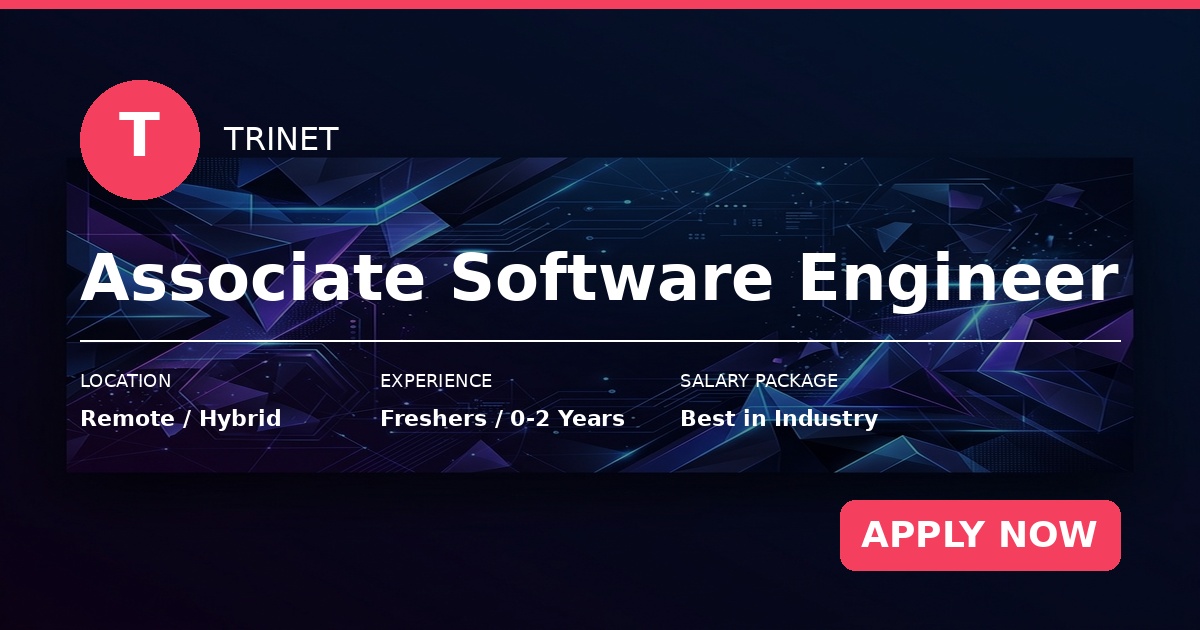
TriNet Off Campus Drive 2026: Hiring Associate Software Engineer
If you are looking to launch your career with a top-tier US technology and HR solutions provider, here is a great opportunity. TriNet is currently inviting applications for the position of Associate Software Engineer. Whether you are a fresh graduate or someone with early tech experience, this entry-level role offers a solid platform to work on modern cloud technology, enterprise HR systems, and scalable software solutions. Read on for complete details regarding eligibility criteria, key skills, responsibilities, selection rounds, and the direct link to submit your application.
Job Overview
| Company Name | TriNet |
| Job Title | Associate Software Engineer |
| Experience Level | Freshers / 0 - 2 Years |
| Qualification | B.E / B.Tech / M.Tech / MCA / M.Sc in CS or IT |
| Work Location | Remote / Hybrid |
| Salary Package | Competitive (Best in Industry) |
About TriNet
TriNet is a publicly traded company on the New York Stock Exchange (NYSE: TNET) and a leading provider of comprehensive human resources solutions for small to midsize businesses (SMBs). TriNet simplifies HR functions for thousands of clients across the United States by managing payroll, employment law compliance, risk management, and comprehensive employee benefits like medical insurance, retirement savings, and workers compensation.
Because TriNet processes massive volumes of payroll and sensitive workforce data daily, its engineering infrastructure relies on scalable, robust, and secure cloud software. Working at TriNet gives engineers direct exposure to enterprise-grade web apps, modern APIs, cloud technology, and modern software architectures while operating in a supportive, collaborative environment.
Role Summary and Work Responsibilities
As an Associate Software Engineer at TriNet, you will work within a dynamic product engineering group. You will help build new features, enhance existing applications, write automated tests, and troubleshoot software issues. Senior engineers and technical leads will guide you through code reviews and design discussions to accelerate your professional development.
- Software Development: Write high-quality, efficient, and well-documented code using modern programming languages such as Java, Python, JavaScript, or C#.
- Feature Implementation: Work on backend API endpoints, user interface components, and database logic for HR, benefits, and payroll management systems.
- Testing and Quality Assurance: Write unit tests, integration tests, and participate in bug fixing to keep production systems stable and reliable.
- Agile Team Collaboration: Take part in daily stand-ups, sprint planning, and retrospectives within a fast-paced Agile/Scrum delivery environment.
- Code Reviews: Submit pull requests and actively incorporate feedback from senior peers to uphold team coding standards and design principles.
- Troubleshooting & Maintenance: Investigate functional defects, monitor service logs, and patch runtime errors reported by software quality engineers or end users.
Eligibility Criteria
TriNet maintains clear standards for entry-level engineering roles. Applicants should ensure they meet the following baseline requirements before applying:
- Education: Bachelor’s or Master’s degree in Computer Science, Information Technology, Computer Engineering, or a closely related technical field.
- Eligible Batches: Recent graduates from 2023, 2024, or 2025 batches, as well as candidates with up to 2 years of relevant software industry experience.
- Academic Standard: Good academic background with consistent performance across 10th, 12th, and graduation levels without active backlogs.
- Technical Mindset: Strong grasp of core computer science fundamentals, object-oriented concepts, logic building, and standard algorithms.
Key Skills & Technical Competencies
To stand out during the application screening and technical interviews, candidates should feel comfortable with the following tools and tech stacks:
- Programming Languages: Strong command over at least one primary object-oriented language like Java, Python, C++, or C#.
- Data Structures & Algorithms: Understanding arrays, linked lists, trees, graphs, sorting, searching, dynamic programming, and complexity analysis (Big-O notation).
- Web Concepts: Familiarity with RESTful APIs, HTTP protocols, JSON, HTML5, CSS3, and modern frontend frameworks like React or Angular.
- Database Management: Working knowledge of SQL relational databases (PostgreSQL, MySQL, Oracle) including writing joins, indexing, and basic queries.
- Version Control: Hands-on familiarity with Git repositories, branching strategies, commit messages, and collaborative workflows on GitHub or GitLab.
- Soft Skills: Strong verbal and written communication, active listening, willingness to learn new tools quickly, and high problem-solving motivation.
Selection Process
The recruitment process at TriNet for software engineering candidates generally involves the following steps:
- Online Profile Screening: The talent acquisition team evaluates resumes based on academic credentials, skills, projects, and relevant coursework or internships.
- Online Technical Assessment: Shortlisted applicants take an online test covering coding challenges, multiple-choice questions on DSA, SQL queries, and core CS fundamentals.
- Technical Interview Round 1: Focuses on live coding, problem solving, data structure optimization, and explaining academic or personal projects detailed on your resume.
- Technical Interview Round 2: Evaluates software engineering practices, system design concepts at a high level, object-oriented principles, and database management.
- HR / Cultural Fitment Interview: A practical conversation focusing on team dynamic, career aspirations, work ethics, communication skills, and employment offer details.
Tips to Prepare & Crack the Interview
Here are a few quick practical tips to help you perform well in TriNet’s assessment rounds:
- Practice standard coding problems on LeetCode or GeeksforGeeks focusing on arrays, strings, dynamic programming, and trees.
- Ensure you can explain every project listed on your resume in depth, including architecture choices, challenges faced, and how you solved them.
- Brush up on SQL query writing, particularly multi-table joins, GROUP BY aggregations, and database normalization concepts.
- Review Object-Oriented Programming (OOPs) concepts like Inheritance, Polymorphism, Encapsulation, and Abstraction with real-world examples.
How to Apply
Follow these simple steps to complete your online application:
- Click on the official Apply Now link given below to visit the official career page.
- Review the job description thoroughly and click on the 'Apply' button on their job portal.
- Create an account or sign in with your email address.
- Upload an updated PDF resume highlighting key programming skills, tech projects, and internships.
- Fill in required details like contact information, education history, and submit the application form.